
Guide
15 Coffee Myths Debunked: What's True and What Isn't
Does coffee dehydrate you? Does dark roast have more caffeine? We debunk 15 common coffee myths using brewing science and trusted health sources.
On This Page7 Sections
Quick Answer
Most coffee myths are misleading rather than completely invented. Coffee can contribute to hydration; dark roast is not automatically higher in caffeine; espresso is more concentrated but a full cup of drip coffee often contains more total caffeine; decaf is not caffeine-free; and properly sealed frozen beans can stay fresh longer.
Coffee advice is full of confident rules: dark roast has more caffeine, espresso is the strongest coffee, boiling water burns the grounds, decaf contains no caffeine, and beans should never be frozen. Some of these claims are false. Others are based on a real effect but ignore serving size, measurement method or context.
This guide separates the useful rule from the myth. Each section gives a fast verdict, explains why the belief persists, and ends with a practical takeaway for buying, brewing or drinking coffee.
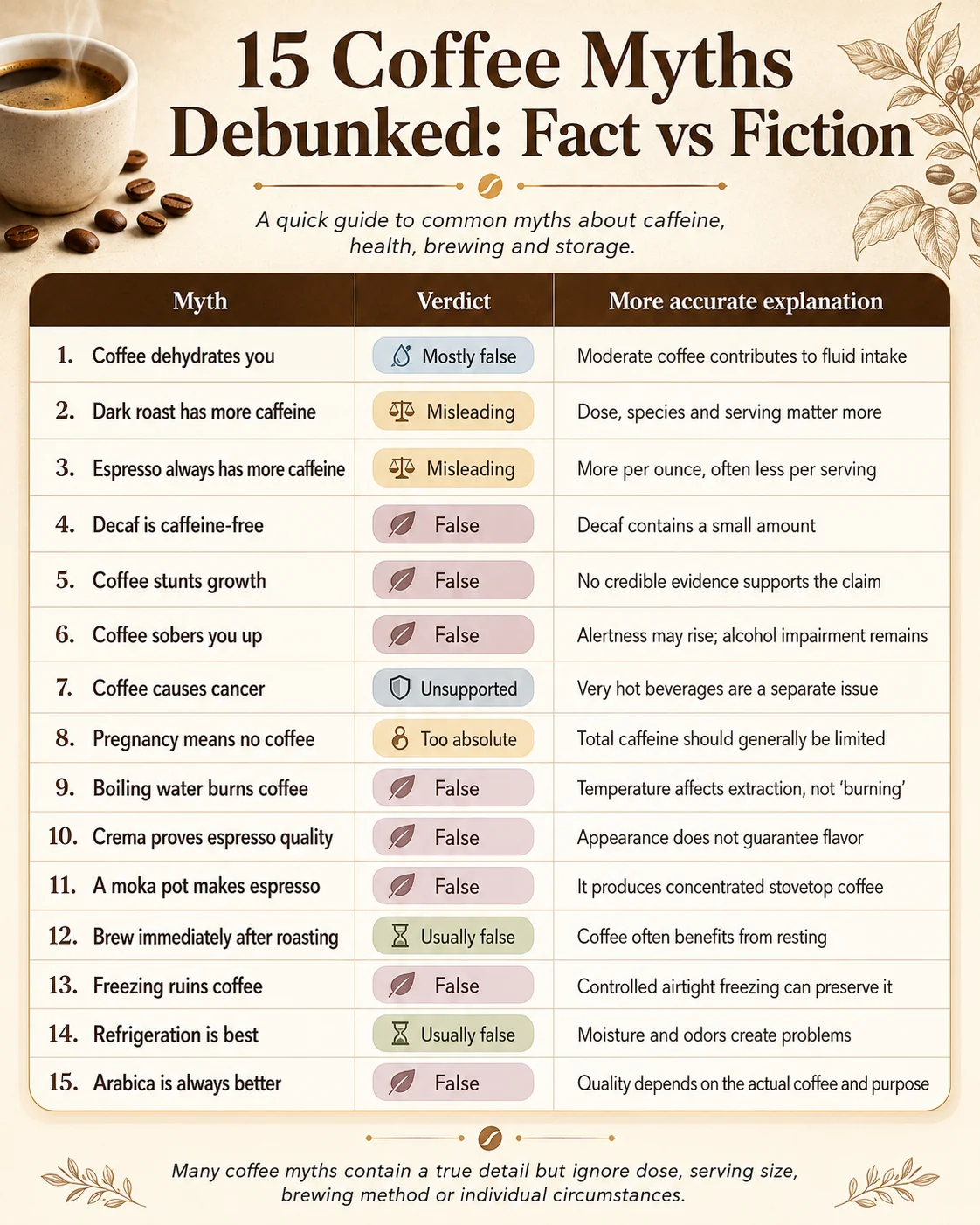
Coffee Myths at a Glance
Key Takeaways
- 1Caffeine concentration and total caffeine per serving are not the same thing.
- 2Roast darkness changes flavor more clearly than it changes caffeine.
- 3Coffee can contribute to hydration, but caffeine tolerance and dose still matter.
- 4Freshness is not a race to brew immediately: degassing and storage conditions matter.
- 5A visible cue such as crema, dark color or surface oil is not a complete quality test.
- 6Health guidance should be individualized for pregnancy, medication use, sleep problems, heart rhythm concerns and caffeine sensitivity.
Health and Caffeine Myths
Myth 1: Coffee Dehydrates You
Verdict: mostly false at ordinary intake levels.
Caffeine can increase urine output, particularly at high doses or in people who are not accustomed to it. That real effect was simplified into the claim that every cup of coffee leaves you dehydrated.
Coffee is still mostly water. In a randomized crossover study of habitual coffee drinkers, moderate coffee intake produced hydration measures similar to water. This does not mean unlimited caffeine is harmless or that coffee should replace all water, but a normal cup generally contributes fluid rather than cancelling itself out.
Context matters during extreme heat, illness, endurance exercise or very high caffeine intake. In those cases, total fluid and electrolyte needs deserve separate attention.
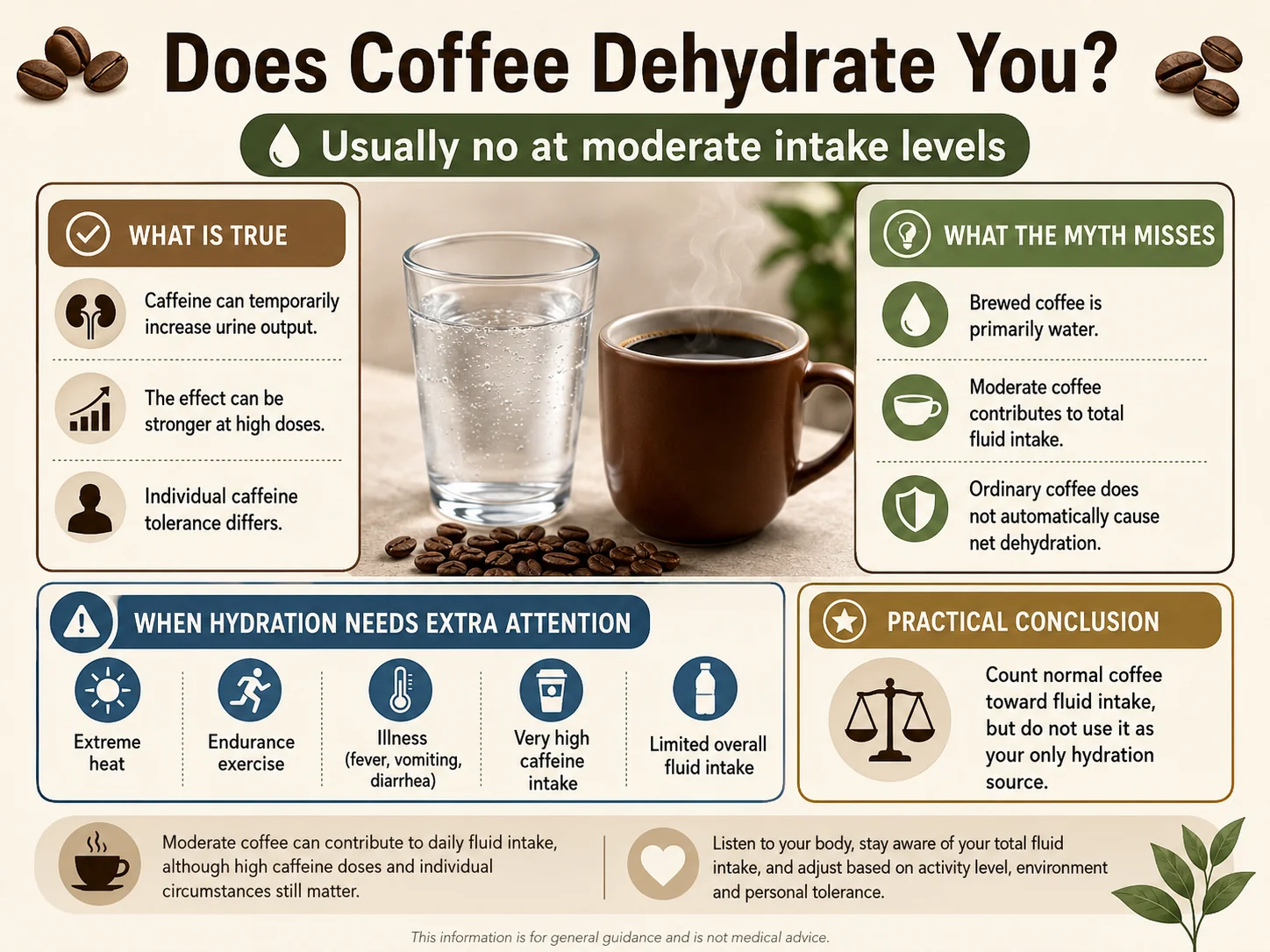
Practical takeaway: count ordinary coffee toward fluid intake, but keep water available and judge hydration from total intake, activity, climate and symptoms rather than from coffee alone.
Myth 2: Dark Roast Has More Caffeine
Verdict: misleading.
Dark roast tastes stronger because roasting develops more bitter, smoky and roast-driven flavors. That sensory intensity is often mistaken for extra caffeine.
Roast level usually creates only a modest caffeine difference compared with bean species, dose, grind, extraction and serving size. Light roast can contain slightly more caffeine when measured by scoop because denser beans pack more mass into the same volume. When coffee is weighed, the difference can narrow substantially and may vary by coffee and roasting process.
The useful point is not that light roast always wins. It is that roast color is a poor shortcut for predicting the caffeine in the finished drink. For flavor context, use the Coffee Roasts Guide.
Practical takeaway: choose roast level for flavor. Use coffee dose, bean species, recipe and serving size when caffeine is the real priority.
Myth 3: Espresso Always Has More Caffeine Than Drip Coffee
Verdict: true per ounce, often false per serving.
Espresso is highly concentrated, so each milliliter normally contains more caffeine than filter coffee. But people rarely compare equal volumes: an espresso may be 25-40 ml, while a mug of drip coffee may be 240-350 ml or more.
That larger serving can contain more total caffeine even though the drink tastes less concentrated. A double espresso, an Americano and a large batch brew can all land in different ranges depending on the coffee dose and cafe recipe.
This is why caffeine comparisons should distinguish concentration from total dose. The same principle applies to cold brew concentrate: judge it after dilution and by the amount actually consumed. For a closer drink comparison, use Cold Brew vs Espresso.
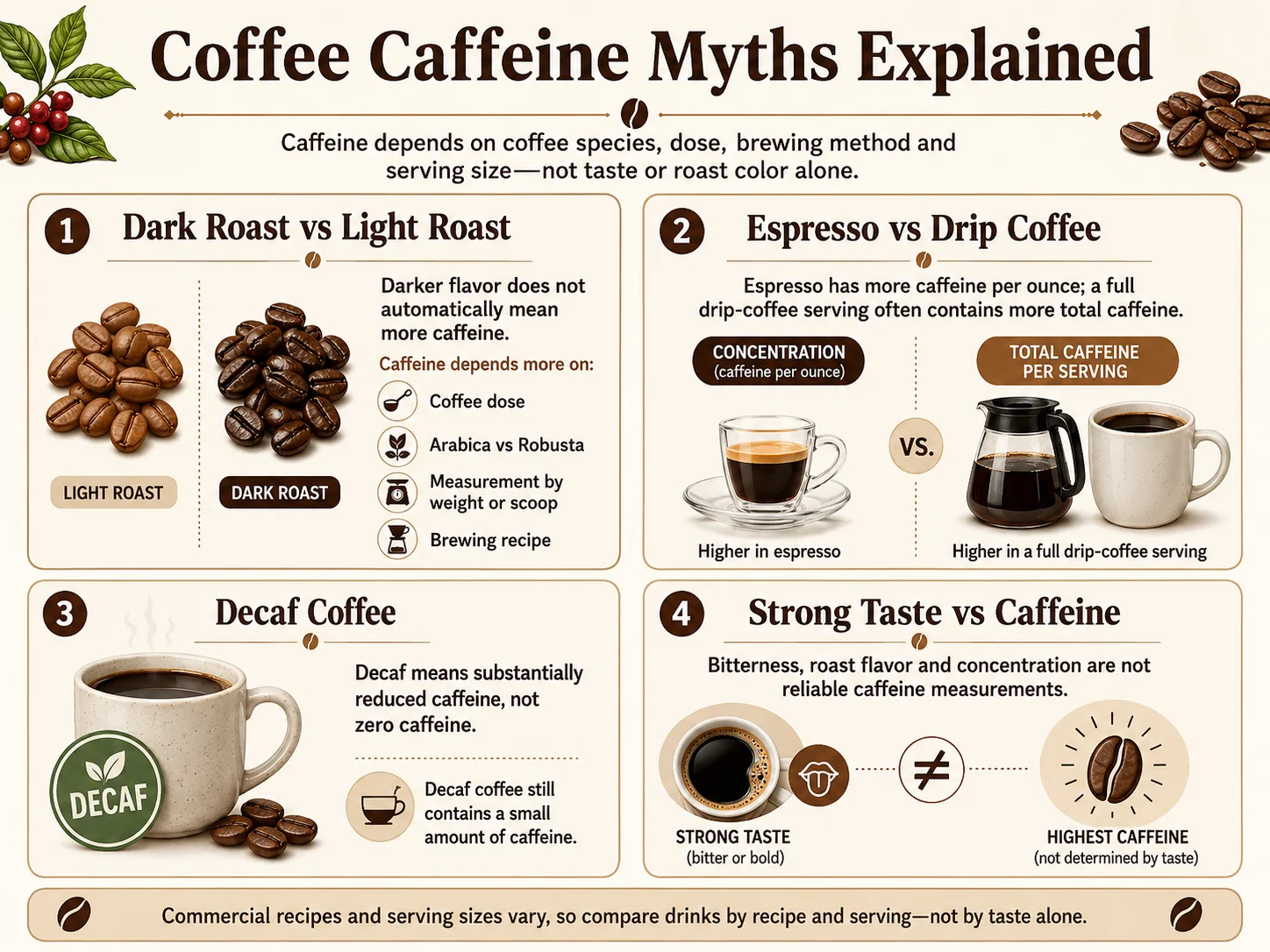
Practical takeaway: compare caffeine per serving, not merely per ounce or by how intense the drink tastes.
Myth 4: Decaf Coffee Is Caffeine-Free
Verdict: false.
Decaffeination removes most caffeine, not necessarily every trace. The FDA states that an 8-fluid-ounce cup of decaf coffee typically contains about 2-15 mg of caffeine.
That is much less than regular coffee, but it can still matter to someone who is extremely sensitive, drinks several cups, takes interacting medication or needs to avoid caffeine completely.
Decaf also varies by bean, decaffeination method, dose and brewing recipe. "Decaf" is therefore best understood as substantially reduced caffeine rather than zero caffeine.
Practical takeaway: choose decaf to reduce caffeine materially, but do not assume it is completely caffeine-free.
Myth 5: Coffee Stunts Growth
Verdict: false.
There is no scientifically valid evidence that coffee determines a person's final height. The myth may have grown from older concerns about caffeine, calcium and bone health, but that does not establish that coffee stops skeletal growth.
This does not make high caffeine intake appropriate for children. Sleep disruption, anxiety, palpitations and the sugar content of many cafe drinks are more relevant concerns for younger consumers.
Adult caffeine guidance should not be copied directly to children or adolescents. The specific claim about height, however, is not supported.
Practical takeaway: do not use height as the reason for limiting caffeine in young people; use age-appropriate health and sleep guidance instead.
Myth 6: Coffee Sobers You Up
Verdict: false.
Caffeine can make an intoxicated person feel more awake. It does not lower blood alcohol concentration or restore judgment, coordination and reaction time.
That mismatch can be dangerous because alertness may create a false sense of control while alcohol-related impairment remains. Cold showers, food and exercise do not provide an instant cure either. The body needs time to metabolize alcohol.
Practical takeaway: never use coffee as evidence that someone is safe to drive or make important decisions after drinking alcohol.
Myth 7: Coffee Causes Cancer
Verdict: unsupported as a general statement.
In 2016, the International Agency for Research on Cancer reviewed more than 1,000 studies and found no conclusive evidence that drinking coffee has a carcinogenic effect. Coffee was therefore not classifiable as carcinogenic to humans.
A separate issue is beverage temperature. IARC classified drinking very hot beverages, around 65 C or above, as probably carcinogenic because of the association with esophageal cancer. The concern is repeated thermal injury from very hot liquid, not a unique property of coffee.
Individual products can also differ. What is added to coffee, smoking and alcohol use, and overall diet may be more relevant to personal health than the coffee label alone.
Practical takeaway: do not describe coffee itself as a proven carcinogen. Let extremely hot drinks cool to a comfortable temperature before drinking.
Myth 8: Pregnancy Means No Coffee at All
Verdict: too absolute.
Caffeine intake during pregnancy should be limited, but complete abstinence is not the universal recommendation. The American College of Obstetricians and Gynecologists states that moderate caffeine consumption below 200 mg per day does not appear to be a major contributor to miscarriage or preterm birth.
The practical challenge is that caffeine comes from coffee, tea, chocolate, energy drinks, soft drinks and some medications. Coffee-shop serving sizes also vary widely, so counting "cups" can be misleading.
Pregnancy is individual. A clinician may recommend a lower limit or avoidance based on symptoms, complications, medication or other factors.
Practical takeaway: track total caffeine in milligrams from all sources and follow the advice of the healthcare professional managing the pregnancy.
Brewing and Strength Myths
Myth 9: Boiling Water Burns Coffee
Verdict: false, but temperature still matters.
Hot water cannot literally re-burn coffee beans in the brewer. The beans have already been roasted at temperatures far above normal brewing water.
The real issue is extraction. Water near boiling can extract quickly and may emphasize bitterness or dryness in a soluble dark roast, especially with a fine grind or long contact time. For many filter and espresso recipes, professional standards and common practice sit around 90-96 C or 195-205 F.
At high altitude, water boils below 100 C, which further shows why "never use boiling water" is too simple. Roast level, method, grind, dose and contact time should be adjusted together. Use the Coffee Brewing Temperature Chart and Coffee Extraction Guide when a cup tastes harsh or thin.
Practical takeaway: use freshly boiled water after a short settling period as a practical starting point, then lower the temperature for dark roasts or harsh cups and raise it for difficult light roasts.
Myth 10: Crema Proves an Espresso Is Good
Verdict: false.
Crema is the foam on an espresso created as pressurized coffee releases carbon dioxide and emulsified material. It can provide information about freshness, coffee composition and extraction conditions, but it is not a flavor score.
Robusta can produce abundant persistent crema. Very fresh coffee may create excessive gas and visually impressive foam while tasting sharp or unbalanced. A stale, over-extracted or bitter shot can still have crema.
The useful test is sensory: sweetness, acidity, bitterness, body, clarity and finish should work together. Appearance is supporting evidence, not the verdict. For the method behind the foam, see the Espresso Guide.
Practical takeaway: taste the espresso before judging it. Treat crema as one clue, not proof of quality.
Myth 11: A Moka Pot Makes Espresso
Verdict: false.
A moka pot makes concentrated stovetop coffee by using steam pressure to push water through a coffee bed. It is stronger than typical filter coffee, which is why it is often marketed as "stovetop espresso."
True espresso uses much higher controlled pressure, a fine compact puck and a short dose-to-yield recipe. The different pressure and extraction systems create different texture, concentration and crema.
Calling moka coffee espresso can also lead to bad recipes: grinding as fine as espresso or tamping the basket may restrict flow and make the pot harsh or unsafe. Treat it as its own method with the Moka Pot Guide.
Practical takeaway: use medium-fine coffee, fill the basket without tamping, control heat and stop before aggressive sputtering.
Beans, Freshness and Storage Myths
Myth 12: Coffee Should Be Brewed Immediately After Roasting
Verdict: usually false.
Roasting creates carbon dioxide inside the porous coffee bean. The release is fastest during the first 24-48 hours and then gradually slows.
If coffee is brewed too soon, escaping gas can disrupt water contact, create an excessive bloom and make espresso difficult to dial in. A short resting period often produces more consistent extraction, although the ideal rest depends on roast development, packaging, brewing method and personal preference.
Freshness still matters. Resting coffee is not the same as leaving an open bag to oxidize for weeks. The Coffee Bloom Guide explains why gas release changes early brews.
Practical takeaway: use the roast date as a guide, keep the bag sealed, and allow very fresh coffee a short rest before deciding that the roast or recipe is defective.
Myth 13: Freezing Coffee Ruins It
Verdict: false when freezing is controlled.
Low temperature slows chemical and physical changes associated with staling. Research summarized by the Specialty Coffee Association indicates that sub-zero storage can materially extend freshness.
The risk comes from poor handling: a loosely closed bag absorbs odors and moisture, while repeatedly opening a cold container allows condensation to form on the beans.
Freezing works best for coffee you will not finish soon. Divide it into airtight single-use or short-use portions, remove excess air, freeze once and let a sealed portion reach room temperature before opening.
Practical takeaway: freeze sealed portions for longer storage; do not repeatedly open and return the same large bag.
Myth 14: The Refrigerator Is the Best Place for Coffee
Verdict: usually false for everyday storage.
Coffee is hygroscopic: it can absorb moisture and surrounding odors. Refrigerators are humid, aromatic environments, and a container that is opened repeatedly experiences temperature changes and condensation risk.
For coffee used within a normal short window, an opaque airtight container in a cool, dry cupboard is generally more practical. Keep it away from ovens, sunlight, dishwashers and other heat sources, and grind only the amount required for each brew.
Refrigeration can work in unusual conditions if the package is genuinely airtight and handling is disciplined, but it should not be the default answer for an opened daily-use bag. For a storage-first walkthrough, use the Coffee Storage Guide.
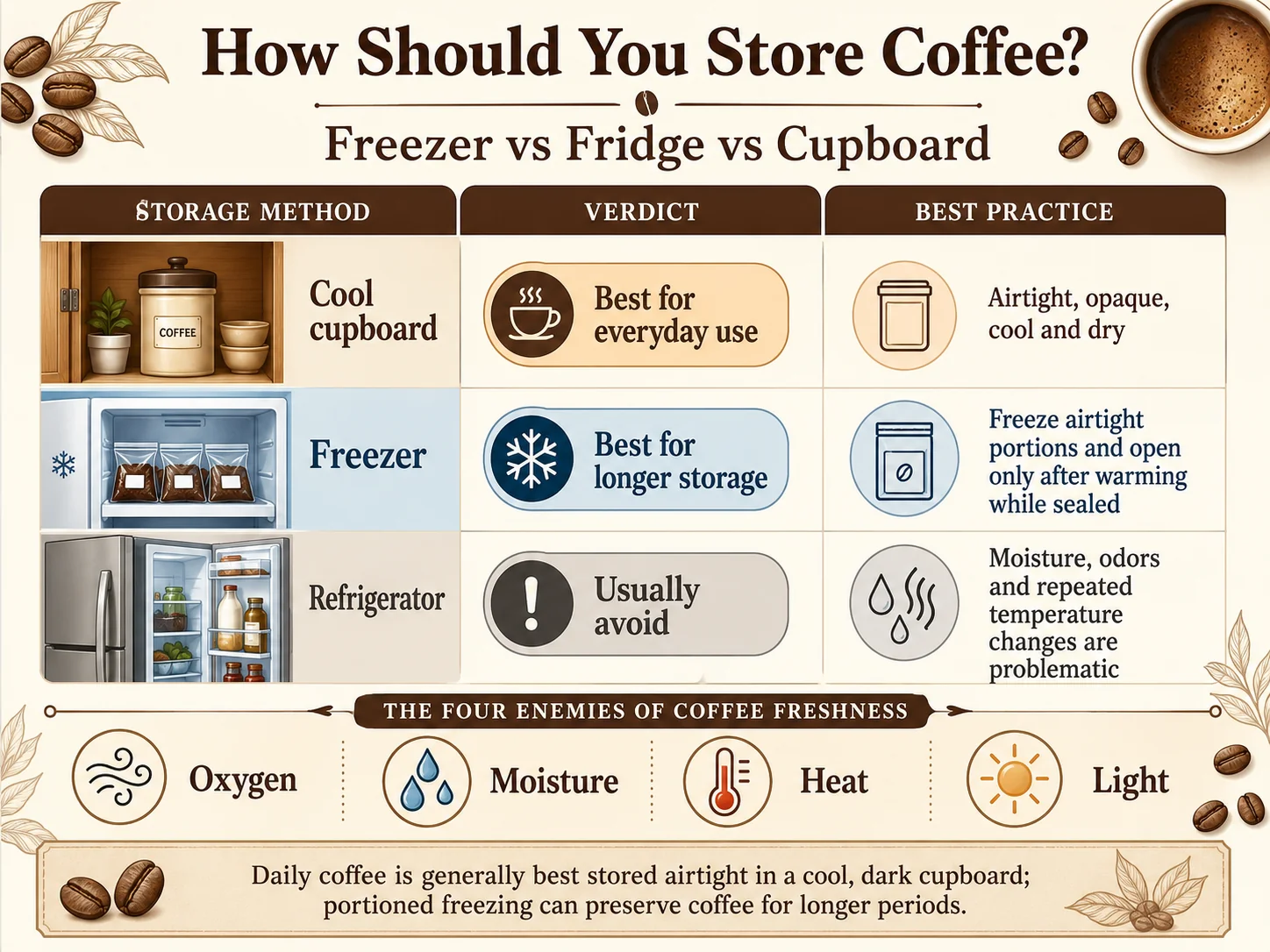
Practical takeaway: store daily coffee airtight, dark, cool and dry. Use portioned freezing rather than routine refrigeration when longer preservation is needed.
Myth 15: Arabica Is Always Better Than Robusta
Verdict: false.
Arabica usually offers more aromatic complexity, sweetness and brightness, while Robusta commonly offers more caffeine, bitterness, body and crema. Those are broad species tendencies, not a universal quality ranking.
Coffee Quality Institute standards explicitly recognize both Specialty Arabica and Fine Robusta. A carefully grown and processed Robusta can outperform a stale, defective or poorly roasted Arabica.
The better choice depends on use. Arabica often excels in clarity-focused filter coffee. Robusta or an Arabica-Robusta blend can be valuable for traditional espresso, milk drinks, body and caffeine. Use Arabica vs Robusta and How To Choose Coffee Beans when comparing actual coffees.
Practical takeaway: judge the actual coffee lot, freshness, processing, roast and brew purpose, not the species name alone.
Bottom Line
The most persistent coffee myths confuse one variable with the entire answer. Dark flavor is not caffeine. Concentration is not total dose. Crema is not quality. Freshness is not the same as brewing immediately, and a species name is not a guarantee.
The better approach is to identify the variable that actually controls the question: serving size for caffeine, total fluid intake for hydration, temperature and contact time for extraction, oxygen and moisture for storage, and lot quality for Arabica versus Robusta.
Use the quick verdicts in this guide as starting points, then follow the linked brewing, roast, storage and bean guides when you need a recipe-level answer.
Frequently Asked Questions
Does Coffee Dehydrate You?
Moderate coffee generally contributes to fluid intake. Caffeine can have a diuretic effect, especially at high doses, but an ordinary cup does not automatically produce net dehydration.
Which Coffee Roast Has the Most Caffeine?
Roast level is not the main determinant. Light roast may provide slightly more caffeine by scoop, while differences by weight can be small. Species, dose, recipe and serving size matter more.
Does Espresso Have More Caffeine Than Coffee?
Espresso usually has more caffeine per ounce. A full mug of brewed coffee often contains more total caffeine because the serving is much larger.
Is Decaf Completely Caffeine-Free?
No. The FDA says an 8-ounce decaf coffee typically contains approximately 2-15 mg of caffeine.
Can Coffee Sober Someone Up?
No. It may reduce drowsiness, but it does not reduce blood alcohol or restore coordination and judgment.
Does Coffee Cause Cancer?
IARC found no conclusive evidence that coffee itself causes cancer. Regularly drinking beverages above about 65 C is a separate temperature-related concern.
Should Coffee Beans Be Stored in the Freezer?
Freezing can preserve coffee when beans are sealed in airtight portions. Repeatedly opening a cold bag can cause condensation and odor absorption.
Is Robusta Lower Quality Than Arabica?
Not automatically. Arabica and Robusta have different typical profiles, and the Coffee Quality Institute recognizes Fine Robusta as a quality category.
Sources and Further Reading
U.S. Food and Drug Administration
Spilling the Beans: How Much Caffeine Is Too Much?Caffeine limits and typical decaf range.
European Food Safety Authority
Scientific Opinion on the Safety of CaffeineAdult caffeine safety context.
PLOS One / PubMed
No Evidence of Dehydration with Moderate Daily Coffee IntakeHydration measures in habitual coffee drinkers.
National Institute on Alcohol Abuse and Alcoholism
Alcohol and CaffeineWhy caffeine does not reverse alcohol impairment.
IARC / World Health Organization
Coffee, Mate, and Very Hot BeveragesCoffee carcinogenicity review and very-hot-beverage distinction.
American College of Obstetricians and Gynecologists
Moderate Caffeine Consumption During PregnancyPregnancy guidance around 200 mg per day.
National Coffee Association
How To Store CoffeeStorage guidance for airtight, cool, dark and dry conditions.
Specialty Coffee Association
Preserving Freshness: A Race Against TimeFreshness, degassing and freezing context.
Coffee Quality Institute
Quality Evaluation ProgramSpecialty Arabica and Fine Robusta quality context.